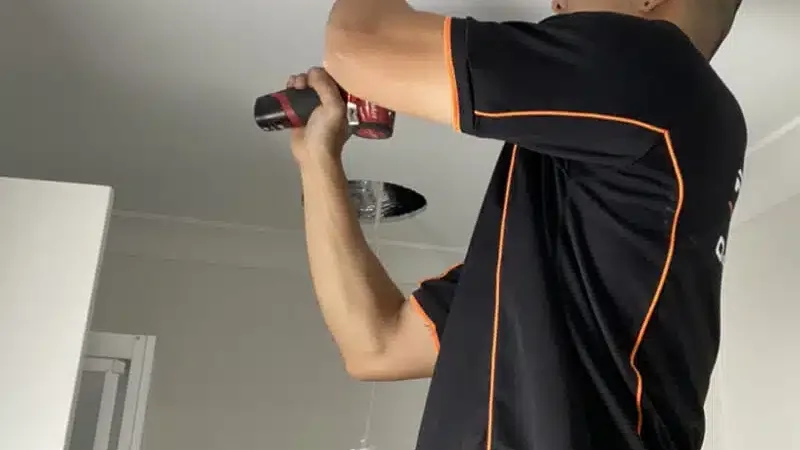
The answer to "what size ceiling fan do I need?" starts with your room's floor area: multiply length by width in metres, then check that figure against the sizing chart for the exact fan you plan to buy. Bigger rooms need a wider blade sweep or a second fan, but brands don't agree on where those lines fall. After that, the blades still need enough height above the floor and space from the walls.
I'm Brian Ho, and at Powerhub Electrical St Ives we help homeowners choose and fit ceiling fans that suit each room. This guide covers why fan size charts disagree, the government minimum fan sizes for daytime living areas, and the blade height and wall clearance limits printed in fan manuals.
Ceiling Fan Size Guide for St Ives Rooms
For an 18 m² room, EGLO's chart suggests 100 to 112 cm, while Hunter Pacific's chart starts at 132 cm, so the two ranges never meet. Here's how three tables compare:
| Room floor area | Hunter Pacific chart | EGLO chart | BASIX minimum, daytime living spaces (zone 5) |
|---|---|---|---|
| 6 m² (2.5 x 2.4 m) | 90 to 122 cm (up to 8 m²) | 70 to 90 cm (under 7 m²) | 1 x 900 mm (under 15 m²) |
| 12 m² (4 x 3 m) | 122 to 132 cm (8 to 16 m²) | 90 to 100 cm (7 to 13 m²) | 1 x 900 mm (under 15 m²) |
| 18 m² (4.5 x 4 m) | 132 to 152 cm (16 to 24 m²) | 100 to 112 cm (13 to 20 m²) | 1 x 1,200 mm (15 to under 20 m²) |
| 22 m² (5.5 x 4 m) | 132 to 152 cm (16 to 24 m²) | 112 to 137 cm (20 to 27 m²) | 1 x 1,400 mm (20 to under 25 m²) |
| 28 m² (7 x 4 m) | 132 to 270 cm or multiple fans (24+ m²) | over 137 cm (27 to 34 m²) | 2 x 1,200 mm (25 to under 30 m²) |
The BASIX column comes from the NSW Planning Portal's BASIX ceiling fan table, which cites National Construction Code 2022, Table 13.5.2. It's a government benchmark for daytime living spaces in climate zone 5 dwellings, not a rule for every fan you buy, and it has no bedroom column.
For your own size calculation, multiply length by width in metres. CHOICE's buying guide suggests measuring the room and checking the retailer's or manufacturer's sizing chart, so use the chart for the model you're buying.
Whichever band you land in, the blades still need to sit at least 2.1 m above the floor, as Fanco's Sanctuary manual states. For a living room, though, a government table may set the minimum size first.
BASIX Ceiling Fan Sizes for New St Ives Homes
Why would a planning rule care what size fan hangs in your lounge room? In NSW it does for some homes, depending on the climate zone and the room's size.
The NSW Planning Portal says a dwelling in NCC climate zone 5 must have at least one ceiling fan in a daytime habitable space, such as a living room. Both the number and diameter of fans depend on the room's size, stepping up to two 1,200 mm fans at 25 m² and two 1,400 mm fans from 30 m².
On the ABCB's climate map, St Ives sits in NCC climate zone 5, which the ABCB describes as warm temperate. That puts a St Ives home going through BASIX inside the fan requirement.
Bedrooms sit outside it, and the Planning Portal frames bedroom fans as an option that reduces the cooling load. The catch is that EGLO's chart puts 13 to 20 m² at 100 to 112 cm, below the 1,200 mm minimum the BASIX table sets for a 15 to under 20 m² living space. Size a living room in that band from EGLO's chart alone and it falls short.
If you're building new, plan the living-room fan points against that table before the plasterboard goes up. When a renovation already has the ceilings open, I'd rather run new fan wiring during house rewiring than cut into a finished ceiling later.
What Size Ceiling Fan for a Bedroom in St Ives
A bedroom fan that roars on low is as annoying as one that barely stirs the air on a hot night. Choosing what size ceiling fan for a bedroom comes down to two things:
Blade Sweep for Small and Master Bedrooms
Sizing a St Ives home often means several bedrooms at once. The ABS 2021 Census found 53.6% of St Ives dwellings have four or more bedrooms, against 33.9% across NSW, with an average of 3.5 bedrooms each.
Hunter Pacific's chart labels rooms up to 8 m² as small bedrooms (90 to 122 cm) and 8 to 16 m² as medium bedrooms (122 to 132 cm). Master bedrooms sit in its 16 to 24 m² band, at 132 to 152 cm.
CHOICE's guide calls a 132 cm (52-inch) fan the standard size and suggests a 122 cm (48-inch) fan for a smaller room. Measure each bedroom separately rather than ordering one size for the whole house.
Speed, Noise and Blade Count
According to CHOICE's fan advice, a 132 cm fan with more than three speeds should deliver the air movement you need for a comfortable night's sleep. Its testing also found the number of blades isn't a factor, with high-performing models having two, three or four blades.
EGLO's guide adds that a slightly larger fan on a lower speed can match the airflow of a smaller fan on high, and run quieter doing it.
A bigger fan turning slowly beats a small fan working flat out, at least on noise. When I quote a ceiling fan installation, each bedroom gets its own measurement and its own size.
Ceiling Fan Height and Wall Clearance in St Ives Homes
Two quick measurements settle whether a fan fits before you buy: floor to ceiling, and blade tip to the nearest wall or beam. Here's what fan manuals ask for on each:
The 2.1 Metre Blade Height in Fan Manuals
Fanco's Sanctuary manual and Voltex's installation manual both say the blades must sit at least 2.1 m above the floor. Those are the manufacturers' own installation rules.
EGLO's guide notes that most Australian ceilings are 2.4 m high. On a 2.4 m ceiling, the 2.1 m minimum leaves 300 mm between the ceiling and the lowest point of the blades, so on a low ceiling, compare that gap with the drop listed in your model's specifications. Our licensed electricians measure floor to ceiling before recommending a model, not after the box arrives.
Wall Clearance and Mounting Strength by Model
Voltex's manual asks for at least 300 mm from the blade tip to the nearest object or wall, and says all electrical work must be carried out by a licensed electrical contractor or electrician. Clearance varies between models, so your own fan's manual sets the figure.
Fanco's Sanctuary manual, for example, asks for a minimum of 500 mm to a wall or beam for best performance, and a mounting structure that supports at least 80 kg. It also says the fan must be installed by a qualified electrical contractor.
If the new fan takes over the centre light point, plan the room's lighting installation at the same time. Skip these checks and the fan you bought may not suit the spot you picked.
Sizing Ceiling Fans for High, Raked and Alfresco Spaces in Ku-ring-gai
Why can a fan that suits a standard ceiling be wrong under a high or sloping ceiling, in a long open-plan room or outdoors? The fittings and the room's shape explain it:
Downrods and Raked Ceiling Kits
CHOICE's advice says ceilings around 2.7 to 3 m or more will most likely need an extension rod. On a slope, many fans can handle an angle of up to about 10 degrees, while ceilings of 20 to 40 degrees will most likely need a raked or angled ceiling kit.
Hunter Pacific agrees that high ceilings generally need a downrod, and notes that vaulted or pitched ceilings may need an additional kit. The safe angle varies by model, and Voltex's installation manual allows pitched ceilings up to 20 degrees, so check the maximum angle before you buy for a raked ceiling.
Open-Plan Rooms and Alfresco Fans
Hunter Pacific says very wide or narrow rooms may need larger fans or several smaller ones, and CHOICE's guide says long rectangular areas benefit from multiple 52-inch fans. The BASIX table moves to two fans once a living space reaches 25 m².
Outdoors, Hunter Pacific's guide says an open-sided area may need an IP66 wet-rated fan. Fanco's Sanctuary manual allows alfresco installation where the fan is covered and ideally enclosed by three walls, with at least 1.5 m from the blade tip to every roof edge.
I'd give each zone of a long room its own fan rather than one oversized fan, and match the outdoor rating to the exposure. Extra fan points can also mean checking the switchboard has room, which I assess in any switchboard upgrade quote.
Conclusion
Choosing a fan size stops being guesswork once you have a tape measure and the right paperwork in hand. The decision comes down to a few measurements you can take yourself, plus a careful read of the documents that come with your fan before anyone climbs a ladder.
Work out the floor area and trust the chart for your model, since brands set their bands differently. For a St Ives living space going through BASIX, the BASIX minimums apply, such as one 1,200 mm fan for 15 to under 20 m².
Keep the blades at least 2.1 m off the floor, as Voltex's manual requires, with the wall gap your fan's manual sets. Get it sorted before summer.
Areas We Service
We fit ceiling fans in homes across Ku-ring-gai and nearby suburbs, including West Pymble, East Lindfield, Turramurra, Hornsby and Normanhurst. Wherever you are, we check the floor area, ceiling height and wall clearance before suggesting a fan size, so the fan suits the space from the first night.
Book Your Ceiling Fan Installation in St Ives
Call Powerhub Electrical St Ives on 0400 332 331 to book a ceiling fan that's sized for your room, hung at the right height and fitted by a licensed electrician, or contact us online:
- $50 off your first service
- 15% pensioner discount
- Free 5-star electrical safety inspection with every booking
- Obligation-free, upfront quotes
- Licensed electrical contractor (Licence No. 467291C)
Frequently Asked Questions About Ceiling Fan Sizes
Is a 52-inch ceiling fan too big for a 12 x 12 foot bedroom?
No, not on Hunter Pacific's chart, which puts a 12 x 12 foot room (about 13.4 m²) in its 122 to 132 cm band. EGLO's chart suggests 100 to 112 cm instead.
Does a new home in St Ives need a ceiling fan under BASIX?
Yes, for the living area. On the ABCB map, St Ives is in NCC climate zone 5, where BASIX requires at least one ceiling fan in a daytime living space. Bedroom fans are optional.
How far should ceiling fan blades be from a wall?
It depends on the model. Voltex's manual asks for at least 300 mm from blade tip to wall, while Fanco's Sanctuary manual asks for 500 mm, so follow your fan's manual.
Do I need a downrod for a 2.7 m ceiling?
In most cases, yes. CHOICE says ceilings around 2.7 to 3 m or more will most likely need an extension rod, and Hunter Pacific says high ceilings generally need a downrod.
Can you put a ceiling fan on a raked ceiling?
Yes, within limits. CHOICE says many fans handle about 10 degrees, while 20 to 40 degree slopes usually need a raked ceiling kit. Voltex's manual allows pitched ceilings up to 20 degrees.
What kind of ceiling fan suits an open alfresco area in Ku-ring-gai?
For open sides, Hunter Pacific says an IP66 wet-rated fan may be needed. Fanco's Sanctuary suits a covered alfresco ideally enclosed by three walls, with 1.5 m from blade tip to roof edges.