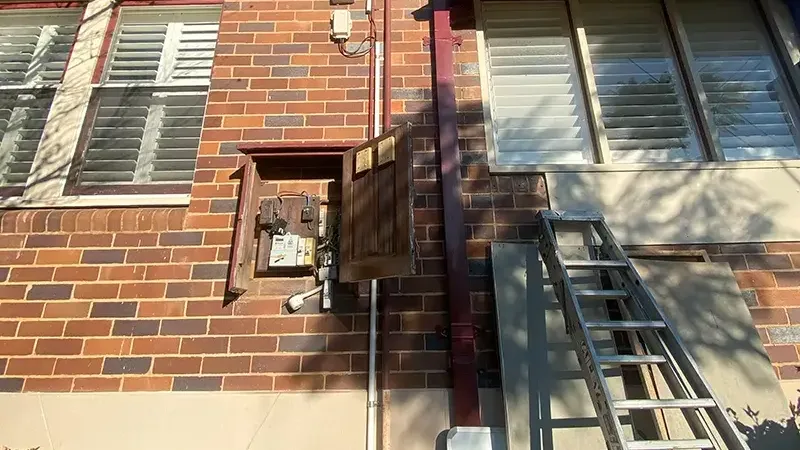
In most cases, yes: a St Ives knock-down rebuild needs a temporary power pole or another builder's supply, because the existing supply is generally disconnected for the demolition and the trades still need power on site. It isn't always a separate pole, though. In some simple rebuilds that keep the meter on site, modifying the existing connection may be enough, and the rules allow other ways to feed the site board.
I'm Brian Ho, and at Powerhub Electrical St Ives we offer Level 2 services, including temporary disconnection and reconnection and new service connections for knock-down rebuilds. This guide covers the disconnect-then-reconnect order, the builder's supply options the NSW rules allow and the safety rules that govern power on a building site.
Temporary Power Pole Basics for St Ives Building Sites
What do NSW rules call a builder's pole? The Service and Installation Rules, the industry code for connecting NSW customers, describe it as an overhead builder's service on a removable or split post.
On a St Ives block, the network side of that arrangement runs through one distributor. Ausgrid's postcode check returns Ausgrid as the distributor for 2075, so its process is the one your rebuild follows, from disconnection to final connection.
The usual order is set out in Ausgrid's rebuild guidance. In most cases you disconnect the existing supply, then apply for a new connection once you're ready to rebuild. Some simple rebuilds, like replacing one home with another and keeping the meter on site the whole time, may only need the existing connection modified instead.
A temporary pole isn't a permanent private power pole, because it's there to power the build and then come down. Whatever feeds the site, SafeWork NSW requires every final sub-circuit of construction wiring to be protected by an RCD with a maximum rated residual current of 30 mA.
SafeWork's supply rules also say construction wiring must be supplied from the distributor's main, the existing switchboard in the permanent installation, a low voltage generator or an inverter. So the first decision is which supply arrangement suits your block.
Builders Pole Alternatives for Ku-ring-gai Knock-Down Rebuilds
Before booking a temp power pole, find out whether an overhead line or an underground cable feeds your block, because that's how the rules group the two main builder's supply arrangements below:
Overhead Builders Service on a Removable or Split Post
Under the NSW installation rules, an overhead service may be installed for building construction, with the service equipment enclosure mounted on a removable pole or post, or on a split post made of two timber sections bolted together. The posts must be in good condition and inspected by the electrical contractor before each use.
This is the classic builders power pole. The rules' notes say these installations are also acceptable for underground distribution systems, and they draw attention to AS/NZS 3012 and SafeWork NSW's codes of practice for construction work.
Underground Builders Service or the New Main Switchboard
In their underground services section, the installation rules let supply be taken via an enclosure that secures the main switchboard in its permanent building position while construction proceeds. The same section makes underground services 4-wire three phase, except for single homes, duplexes and builder's services, where a 2-wire single-phase service is permissible if the cable doesn't need a direct buried joint. If you're weighing three-phase supply for the new home, raise it early.
SafeWork NSW's fact sheet adds that a construction switchboard intended for permanent use must comply with AS/NZS 3000 and AS/NZS 3012. A separate pole keeps site power apart from the new house, while the switchboard option skips the pole but brings the permanent board's compliance forward.
Ausgrid Temporary Power Connection Steps for St Ives Rebuilds
The demolition crew is booked, yet the old house still has live power and nobody has lodged the paperwork. Avoid that stall with the sequence a St Ives rebuild typically follows:
- Check and disconnect. First check for a second connection, such as street lights or lights on exterior walls. Ausgrid's disconnection page asks for written approval from the owner (or their agent), the occupier if different and your retailer, and many customers ask an electrician to complete the form. Ausgrid then issues a job number, a qualified electrical professional does the work and your retailer removes the meter.
- Apply for the builder's supply. Ausgrid's ES1 rules give new installations, which generally include temporary builder's supplies, a new National Metering Identifier (NMI). The exception is a new builder's supply where one house is demolished and the site redeveloped for one new house only: the existing service line counts as relocated, with no new NMI and no Site Establishment Fee. When that supply comes down, the notices for the recovered and new metering and service lines go to Ausgrid together.
- Connect, test and certify. Your Level 2 Accredited Service Provider (ASP) connects the service, and SafeWork NSW says a licensed electrician inspects and tests construction wiring before energisation. The electrician should then send the Certificate of Compliance for Electrical Work (CCEW) within 7 days to the customer (the principal contractor), the network owner for new or upgraded connections and Building Commission NSW. Under the Service and Installation Rules, the ASP or metering provider can't energise past the main switch without a copy of the CCEW or one they completed themselves.
That relocation path is written for one home replacing one home. Ku-ring-gai Council records that in February 2025 the NSW Government permitted terraces, townhouses and 2-6 storey apartment buildings within 800 m of Ku-ring-gai train stations and St Ives town centre, and those projects fall outside it.
Temporary Site Power Safety Rules on NSW Building Sites
One look at the site switchboard tells you whether temporary site power is set up properly. Run through these checks before the first trade plugs in a saw, a mixer or an extension lead.
SafeWork NSW says AS/NZS 3012:2019, the standard for electrical installations on construction and demolition sites, is called up as mandatory by section 163 of the Work Health and Safety Regulation 2025. That makes it the starting point for temporary power pole requirements.
SafeWork's switchboard rules require the site switchboard to sit on a stable, free-standing structure such as a pole, post or wall, with at least IP23 protection and doors that lock overnight or when not in use. Every final sub-circuit of construction wiring must be protected at the board by type A safety switches (RCDs) rated at no more than 30 mA.
Household gear stays off the job, because domestic power boards, double adaptors and piggyback plug adaptors aren't allowed on construction and demolition sites. Under SafeWork's testing intervals, construction wiring gets a visual re-inspection at least every six months, and portable tools, leads and portable RCDs are tested at least every three months. A portable RCD also needs a push-button test every time it's used, and fixed RCDs need one monthly.
Skip the push-button tests and a failed RCD can sit on the site board unnoticed. You'd only find out when a damaged lead or tool needs it to trip, and it doesn't.
Owner, Builder and Level 2 Roles in a Temporary Builders Supply
Who organises site power, the builder, the electrician or the owner? The Service and Installation Rules say the owner or occupier seeks the distributor's approval for connection services, and each party plays a part:
- Owner and occupier. You (or your agent) give written approval for the disconnection, along with the occupier if different and your retailer. Ausgrid's disconnection process notes many customers ask an electrician to complete the application.
- Builder. Agree in writing who arranges the builder's supply before demolition is booked, so neither you nor the builder assumes the other has it covered.
- Licensed electrical contractor. Ausgrid's contractor rules state that all work inside the customer's property must be carried out by a licensed electrical contractor.
- Level 2 ASP. Energy NSW states that in NSW, only accredited providers can perform contestable network services. Accreditation at Level 2 covers constructing or changing service lines between the network and the point of connection, and energising new or altered connections, and we provide Level 2 electrical services for rebuilds.
- Retailer. Under Ausgrid's ES1, a new connection needs a retail contract, which the applicant and customer arrange, before energisation. Only after the retailer notifies Ausgrid does Ausgrid issue the job number your ASP uses to collect the metering.
Before anyone touches the service line, ask whoever quotes the network work for their ASP accreditation details. Our licensed team can take your questions on the network side and the site board together.
Conclusion
Plan the power before you plan the demolition. Ausgrid's guidance says that in most cases the old supply comes off first and a new connection follows once you're ready to rebuild, though a simple one-for-one rebuild keeping the meter on site may only need a modified connection.
A builder's pole is one way to bring the distributor's supply on site, and SafeWork NSW also lists the existing switchboard in the permanent installation, a generator and an inverter. Whichever source you use, every final sub-circuit on the site board needs a 30 mA type A RCD, and household power boards stay off the job. Sort the order, the arrangement and the board early, and site power won't hold up the build.
Areas We Service
We handle temporary disconnection and reconnection, plus new service connections for knock-down rebuilds, across Gordon, Killara, Wahroonga, Roseville Chase and Belrose. On any of those blocks, find out early whether the supply comes in overhead or underground, and plan the builder's supply around the answer before the demolition date is set.
Book Your Temporary Power Connection in St Ives
Call Powerhub Electrical St Ives on 0400 332 331 or book online to plan the disconnection, builder's supply and new connection for your St Ives knock-down rebuild:
- $50 off your first service
- 15% pensioner discount
- Free 5-star electrical safety inspection with every booking
- Obligation-free, upfront quotes
- Licensed electrical contractor (Licence No. 467291C)
Frequently Asked Questions About Temporary Builders Supply
Do I need to disconnect the power before demolishing a house in St Ives?
Yes, in most cases. Ausgrid's process is to disconnect the existing supply, then apply for a new connection, but a simple rebuild that keeps the meter on site may only need a modified one.
Can the new main switchboard supply power during construction?
Yes. The underground services section of the NSW installation rules lets supply come through an enclosure securing the switchboard in its permanent position, and that board must meet AS/NZS 3000 and AS/NZS 3012.
Does a temporary builder's supply get a new NMI?
Usually, yes. Ausgrid's ES1 says new installations, which generally include temporary builder's supplies, get a new NMI, but one house replaced by one new house counts as a relocated service line instead.
Can trades plug household power boards into a builder's pole?
No. Domestic power boards, double adaptors and piggyback adaptors aren't allowed on construction and demolition sites in NSW, and each final sub-circuit of construction wiring must have a 30 mA type A RCD.
Who lodges the disconnection application with Ausgrid?
Either you or your electrician. Ausgrid needs written approval from the owner, the occupier if different and your electricity retailer, and many customers ask an electrician to complete the online application for them.
What happens to the builder's pole when the new home is finished?
It's removed, with the paperwork lodged as a pair. For a single new home, Ausgrid's ES1 requires the notices for the recovered and the new metering and service lines to go in together.